


























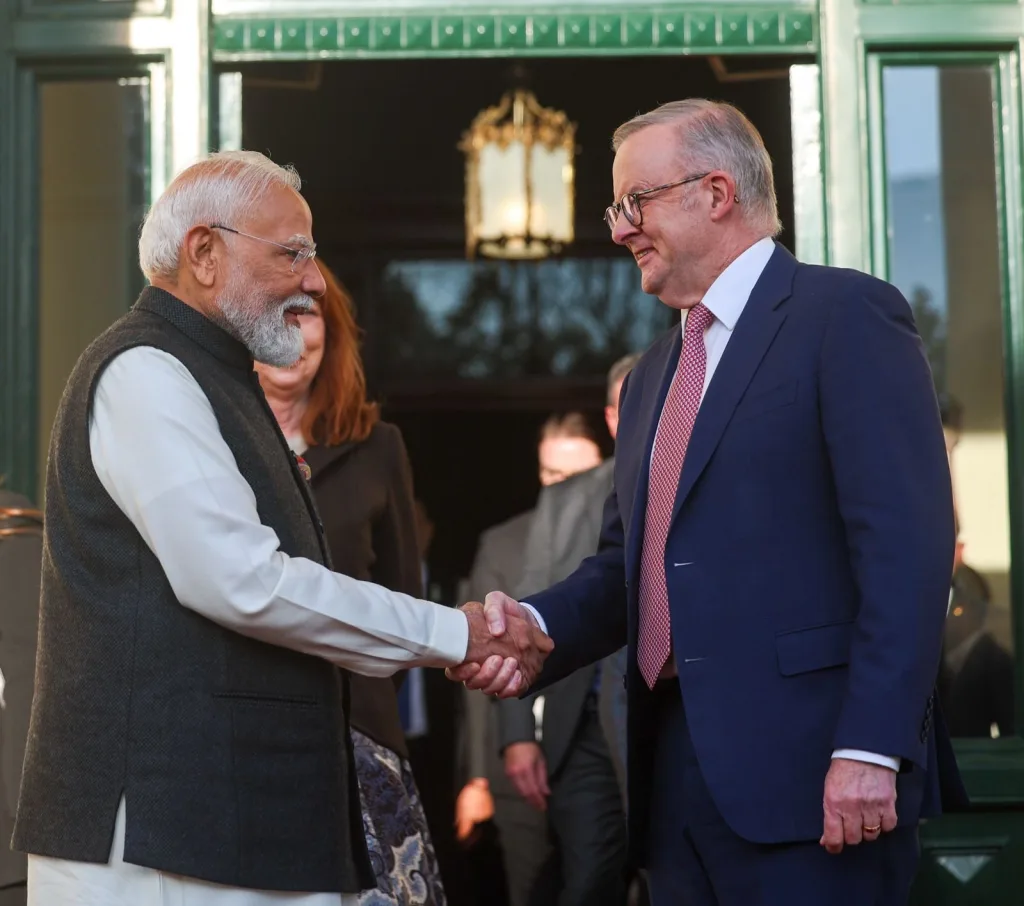
Prime Minister Narendra Modi’s visit to Australia has resulted in a major breakthrough for India’s clean energy ambitions, with both countries agreeing to operationalise long-term Australian uranium supplies for India’s civilian nuclear programme.
Describing the pact as an “important agreement”, PM Modi said Australian uranium would provide “fresh momentum” to India’s clean energy goals. Australian Prime Minister Anthony Albanese said the arrangement would support India’s efforts to expand its non-fossil fuel electricity generation.
According to both governments, uranium exports will remain under the safeguards of the International Atomic Energy Agency (IAEA) and will be used exclusively for peaceful civilian purposes.
The agreement is being viewed as one of the most significant outcomes of PM Modi’s Australia visit, alongside cooperation in defence, critical minerals, maritime infrastructure and space.
Why is Australian uranium important for India?
India has set an ambitious target of increasing its nuclear power generation capacity from around 8 GW to 100 GW by 2047 as part of its long-term clean energy strategy.
Achieving that goal will require dozens of new reactors and, more importantly, a steady supply of uranium fuel.
Addressing the joint press meet with PM Albanese.@AlboMP https://t.co/CZ96A4au2x
— Narendra Modi (@narendramodi) July 9, 2026
Although India has uranium deposits in Jharkhand, Telangana, Andhra Pradesh and Rajasthan, domestic production has historically remained below demand because of limited reserves, lower-grade ore and mining challenges.
Australia, which holds nearly 28 per cent of the world’s known uranium reserves, offers India a reliable and politically stable long-term source of nuclear fuel. The agreement will also diversify India’s uranium imports, which currently come from countries including Kazakhstan, Canada, Russia, Uzbekistan and Namibia.
How does the deal strengthen India’s nuclear roadmap?
The agreement complements India’s three-stage nuclear programme envisioned by nuclear scientist Homi Bhabha.
The initial phase uses PHWRs fueled with natural uranium, while subsequent phases use fast breeder reactors and ultimately advanced reactors based on thorium.
While India tries to tap into its rich deposits of thorium, uranium continues to be crucial to fueling the present and future reactors.

This deal is also consistent with India’s efforts towards reducing its carbon emissions and attaining zero carbon emission status by 2070. Nuclear power plants unlike solar and wind power plants generate uninterrupted power, thus playing a vital role in India’s future energy plans.
In addition to being about energy, this deal has helped to consolidate India-Australia Comprehensive Strategic Partnership. Both sides have also reached out for deeper cooperation in areas like defense, critical minerals, security in the Indo-Pacific region and space technology during the visit of PM Modi.
FAQs
Why is Australia exporting uranium to India?
Australia exports uranium to India for its peaceful nuclear power program under the IAEA safeguards.
How will the uranium deal benefit India?
The agreement will support India’s plan to expand nuclear power capacity, diversify uranium imports, reduce dependence on fossil fuels and strengthen long-term energy security.