












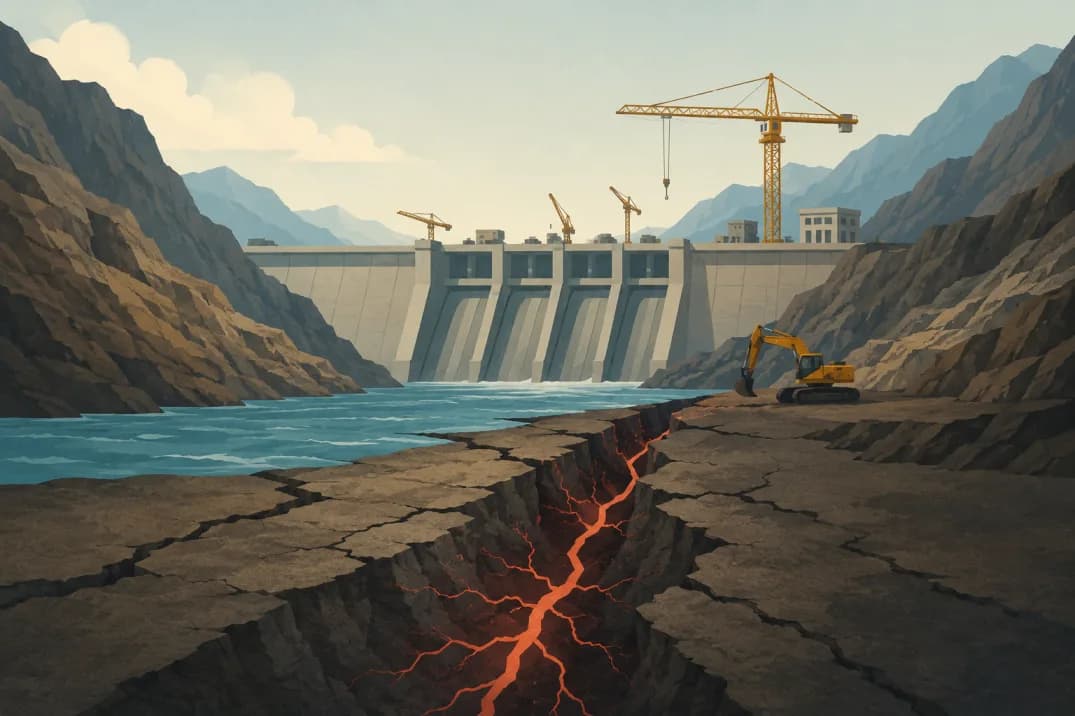













Chinese geologists have warned that an active fault line runs directly beneath the vast hydropower project China is building on the Yarlung Tsangpo River in Tibet. This development has revived questions about the project’s structural safety.
The warning comes from a paper published last month in a Chinese-language journal, supervised by the state-run China Geological Survey.
The study says the fault could threaten the stability of nearby infrastructure as construction advances on what is being described as the world’s largest hydropower project.
Also Read | Railways clarifies rule: WhatsApp ticket copies not valid for travel
China’s plan to build the world’s largest #Hydropower project on the #YarlungTsangpoRiver in #Tibet has come under fresh scientific scrutiny after a study by its own government-backed geologists have warned that the #MegaDam sits above an active fault line capable of… pic.twitter.com/dAFxZj7XJd
— Upendrra Rai (@UpendrraRai) July 10, 2026
Beneath the surface lies the real challenge
The researchers identified the Paizhen Fault as the main concern.
The Paizhen Fault, which has been highly active since the Pleistocene (also known as the Ice Age), will have a major impact on the structural stability and construction of nearby structures, including dams, roads, bridges, and tunnels, as well as the reservoir area.
The fault had fractured surrounding rock formations and weakened their mechanical properties, making nearby infrastructure more vulnerable to damage.
The study also said the terrain had a “loose structure and weak cohesion” and warned that instability on both sides of the reservoir area could be triggered after long-term immersion, fault activity, and earthquakes.
🔴 China's mega-dam on the Yarlung Tsangpo (Brahmaputra) — set to be the world's largest hydropower project — sits directly above an active fault line, Chinese geologists warn.
— BodhiDharma (@Bodhi_D_dharma) July 9, 2026
A new study (Chengdu University of Technology + China Geological Survey) found the Paizhen Fault has… pic.twitter.com/ssT18ySpj2
Science delivers a sober caution
The paper was jointly conducted by geologists from the Chengdu University of Technology, the Civil-Military Integration Center of the China Geological Survey, and the Middle Yarlung Zangbo River Natural Resources Observation and Research Station.
It recommended slope-stabilization measures and retaining structures to reduce the risk of landslides and collapses during construction and operation.
The study also pointed to the Himalayas’ seismically active setting and cited the 2017 magnitude 6.9 earthquake in Milin, Tibet, near the northern end of the fault line as evidence that seismic risk remains alive in the region.
#WATCH | Dibrugarh, Assam | Brahmaputra erosion continues in parts of Dibrugarh as siltation concerns emerge near Bogibeel
— ANI (@ANI) July 10, 2026
River expert & former Geology professor, Jogendra Nath Sharma says, "Dibrugarh is under the grip of Brahmaputra. So the channel which was away from the… pic.twitter.com/XCPoJ6Vr4o
Why does this matter to India and Bangladesh?
Work on the project began on the Tibetan Plateau last year. It is projected to generate about 300 billion kilowatt-hours of electricity a year, which is nearly three times the capacity of the Three Gorges Dam.
The river leaves Tibet as the Siang in Arunachal Pradesh. Then it becomes the Brahmaputra in Assam and later flows into Bangladesh as the Jamuna, making any upstream instability a matter of concern far beyond China’s borders.
The project has already raised water security and environmental concerns in downstream countries. China has said it has communicated with relevant neighbors, promising that the dam will not adversely affect downstream areas.
Also Read | Why are Maharashtra doctors protesting? Thane hospital assault case explained
FAQs
Q1: Why is China’s Brahmaputra mega-dam facing a natural threat?
Chinese geologists say the dam site lies on the active Paizhen Fault, which could increase risks from earthquakes, landslides and unstable terrain.
Q2: Why is China’s Brahmaputra dam important for India?
The Brahmaputra flows from Tibet into India and Bangladesh, making any major upstream project significant for downstream water security and environmental concerns.