







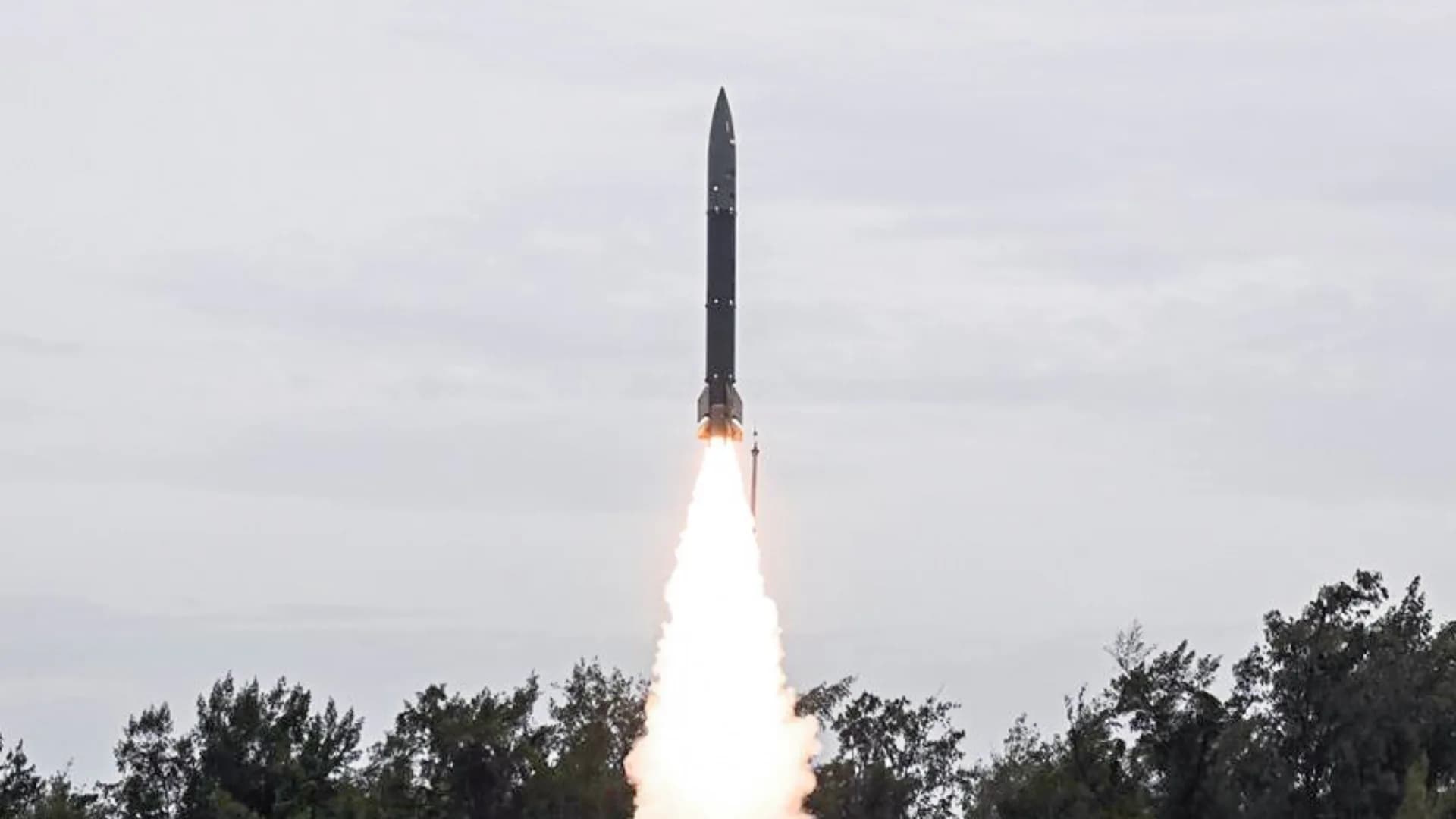


















India is preparing to allow private defence companies to manufacture advanced missiles, marking a significant shift in the country’s defence production strategy. The move comes as Indonesia has shown interest in acquiring the Astra beyond-visual-range (BVR) air-to-air missile developed by the Defence Research and Development Organisation (DRDO).
According to reports, the defence ministry has decided to open the strategic missile sector to private Indian firms as the state-owned Bharat Dynamics Ltd (BDL) is unable to meet the increasing requirements of the armed forces alongside rising export demand from friendly countries.
The ministry is expected to soon issue a request for proposal (RFP), inviting leading private players such as ICOMM, Adani, Bharat Forge, the Tata Group and the Mahindra Group to manufacture the Astra Mark 2 missile, which has a strike range of around 180 to 200 km.
Also Read | Indian Navy inducts INS Mahendragiri, adds indigenous stealth frigate to Eastern Fleet
The missile has been successfully tested and is designed to counter China’s long-range PL-15E air-to-air missile that was supplied to Pakistan ahead of Operation Sindoor last year. Once inducted, Astra Mark 2 will be integrated with Tejas Mark 1-A, MiG-29, Su-30 MKI and Rafale Marine fighter aircraft.
Pralay missile could be next for private sector
Reportedly, sources said the next major missile programme that may be opened to private industry is the Pralay tactical ballistic missile. The two-stage missile has a reported range of 500 km and travels nearly six times the speed of sound.
Pralay forms part of India’s Integrated Rocket Force, which also includes the long-range land attack cruise missile (LRLACM), the next-generation BrahMos missile and the extended-range Pinaka multi-barrel rocket launching system capable of striking targets up to 300 km away.
India accelerates missile and air defence expansion
Following Operation Sindoor, the Centre is focusing on rapidly expanding India’s missile and rocket inventory to strengthen deterrence capabilities. Alongside offensive systems, emphasis is also being placed on strengthening defensive missile shields.
Also Read | Indian Army plans procurement of 450 Carl Gustaf Mk-IV rocket launchers
India and Israel are jointly working on a long-range surface-to-air missile for naval platforms. At the same time, a multi-layered anti-missile and anti-drone network is being developed to counter Turkish drones used by Pakistan, as well as long-range rockets and ballistic missiles deployed by China’s People’s Liberation Army (PLA).
The fifth S-400 air defence system is expected to arrive in India in November. The government is also planning to approve the procurement of five additional S-400 systems from Russia. These air defence units will be protected by the Russian Pantsir system against kamikaze drones and rocket attacks.
FAQs:
Why is India opening missile manufacturing to private companies?
The Centre plans to boost missile production capacity, meet military demand and support defence exports by involving private firms.
What is the Astra Mark 2 missile and which aircraft will use it?
Astra Mark 2 is a DRDO-developed 180-200 km beyond-visual-range air-to-air missile that will be integrated with Tejas Mk1A, MiG-29, Su-30 MKI and Rafale Marine fighters.