




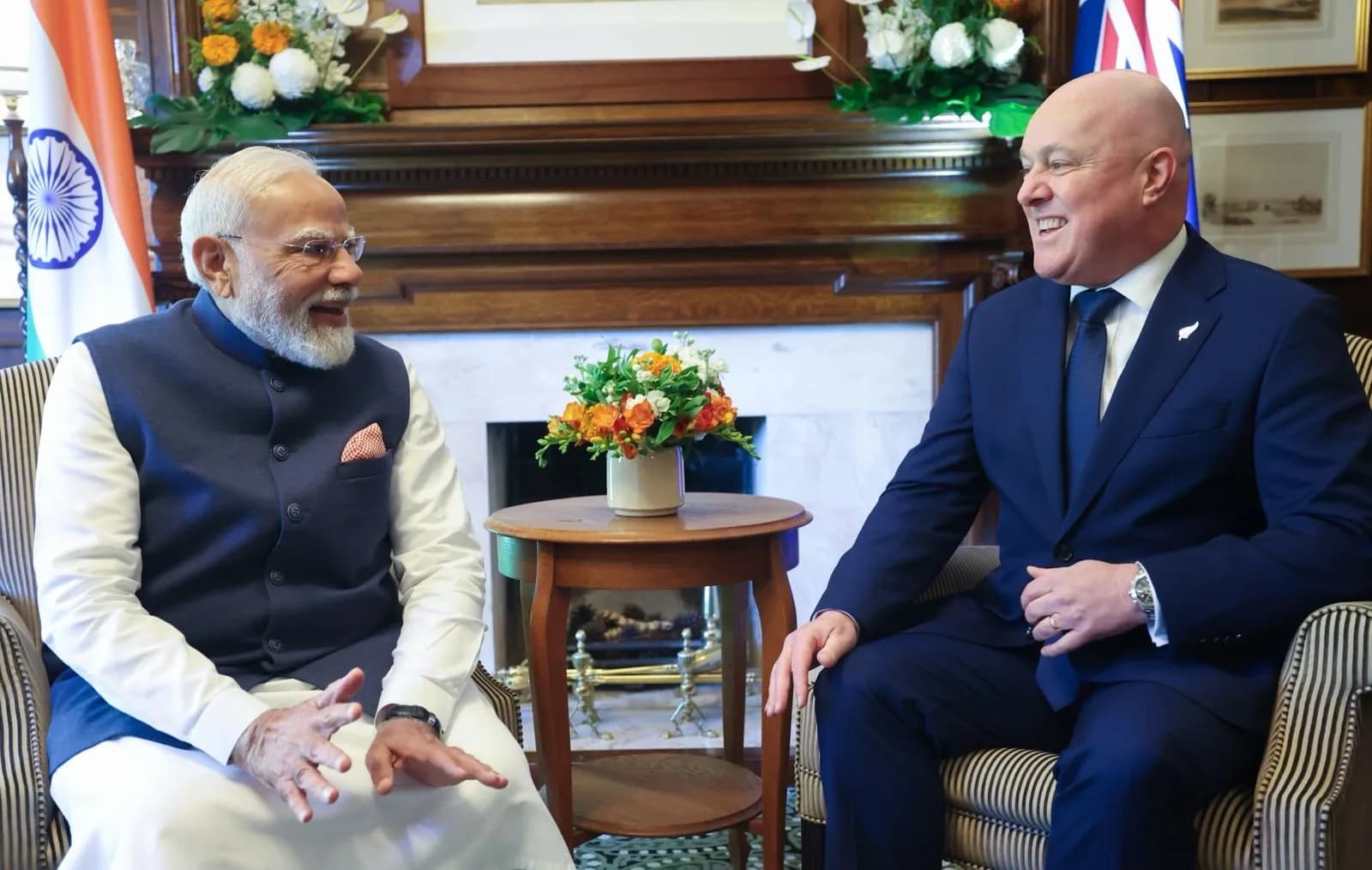
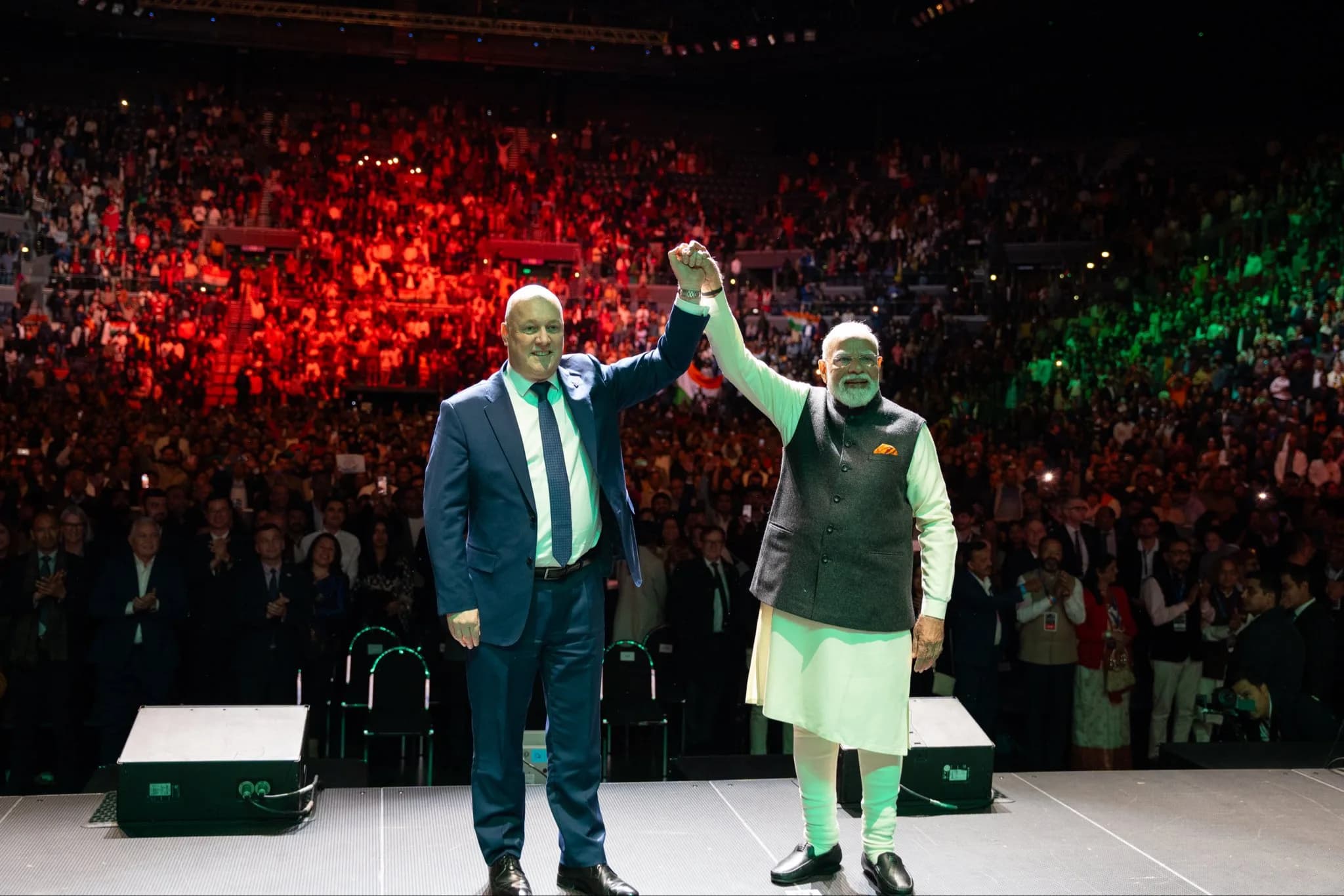










India and New Zealand on Saturday elevated their relationship to a strategic partnership after talks in Auckland between Prime Minister Narendra Modi and New Zealand Prime Minister Christopher Luxon. This move, the two sides said, would provide a framework for deeper cooperation over the next four years.
The leaders also set a target of doubling bilateral trade in goods and services by 2030 to about ₹35,000 crore, while reiterating that the relationship would now be driven by a longer-term roadmap rather than isolated sectoral deals.
Also Read | Delhi plans 7-seater electric vans to boost last-mile connectivity
🇮🇳🇳🇿 #India, #NewZealand upgrade ties to strategic partnership, announces New Zealand PM Luxon.
— Mahalaxmi Ramanathan (@MahalaxmiRaman) July 11, 2026
—India and New Zealand have set a target to double bilateral trade to ₹35,000 crore by 2030.
New Zealand will also join the Indo-Pacific Oceans Initiative (#IPOI) and the Global… pic.twitter.com/6qsdp4lJ6E
A handshake with long horizons
The visit carried added diplomatic weight as it was the first by an Indian prime minister to New Zealand in 40 years.
The joint statement said the two leaders had discussed the full range of bilateral ties, including trade and investment, defense and security, agritech, sports, education, tourism, culture, and people-to-people links.
It also said they endorsed the “India-New Zealand Strategic Partnership: Roadmap to 2030” as a framework to guide joint action and deepen cooperation bilaterally and multilaterally.
New Zealand and India have agreed a new deal that builds on our free trade agreement.
— Christopher Luxon (@chrisluxonmp) July 12, 2026
With Prime Minister @narendramodi here in New Zealand, we’ve lifted our relationship to a Strategic Partnership, with a plan to double trade between our countries by 2030 – meaning more money… pic.twitter.com/r1JS2VUXCh
Ink meets intent
The talks also produced a series of agreements and understandings across defense and maritime security, hydrography, sports, disaster management, dairy, tourism, maritime heritage, culture, food technology, and ocean research, according to the Prime Minister’s Office.
The official readout said both leaders underlined the importance of early implementation of the India-New Zealand Free Trade Agreement and agreed to work toward stronger cooperation in multilateral forums.
A shift on the Indo-Pacific chessboard. 🇮🇳🤝🇳🇿
— Sanjay Srivastava (@Sanjay_Sriv) July 11, 2026
The doors open wide for a 40-year strategic pivot.
India and New Zealand are officially engineering the nodes of a New Indus Route. With the formal elevation of ties to a Strategic Partnership announced in Auckland, this… pic.twitter.com/LsmnqYoZRm
The tides favour closer company
Maritime cooperation emerged as a central theme in the new framework. The joint statement said the two sides would strengthen engagement in the Indo-Pacific, preserve freedom of navigation and overflight under international law, and safeguard sovereignty, territorial integrity, and a rules-based international order.
The official document also recorded their shared support for a free, open, and prosperous Indo-Pacific, while the outcomes list included a maritime security dialogue and measures to improve coordination and information exchange between the two sides.
🇮🇳🤝🇳🇿 India & New Zealand Launch a New Strategic Partnership
— Zest (@Zest328117) July 12, 2026
In a landmark development, India and New Zealand have formally elevated their bilateral relationship to a Strategic Partnership, opening a new chapter in defence, trade, technology, agriculture and Indo-Pacific… pic.twitter.com/3mXyG04ASR
What comes next for the new strategic partnership?
The joint statement further said Modi and Luxon exchanged views on regional and global developments, including tensions in West Asia and the war in Ukraine, and reiterated their condemnation of terrorism in all its forms, including cross-border terrorism.
They also agreed to regular political engagement and to build on the new partnership through sustained contact between ministers and officials.
For both governments, Saturday’s talks were presented not as a symbolic reset but as the start of a more structured phase in the bilateral relationship.
Also Read | Badrinath Dham donation scam? CCTV, call records take centre stage in SIT investigation
FAQs
Q1: Why did India and New Zealand elevate their ties to a Strategic Partnership?
India and New Zealand upgraded their relationship to deepen cooperation in trade, defence, maritime security, technology and regional affairs through a Roadmap to 2030.
Q2: What is the India-New Zealand trade target for 2030?
The two countries have set a goal of increasing bilateral trade in goods and services to around ₹35,000 crore by 2030.