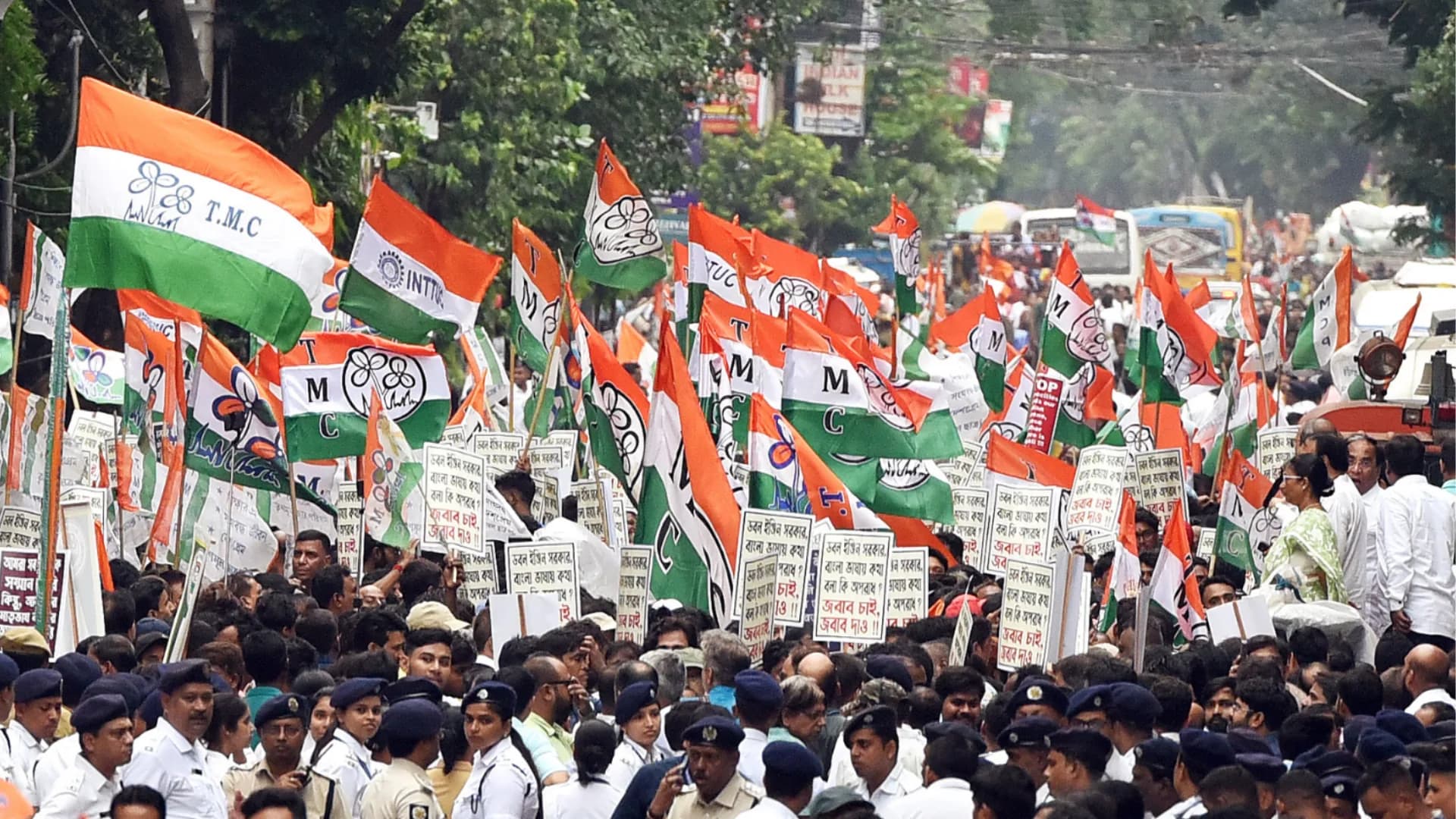





















The All India Trinamool Congress, founded by Mamata Banerjee, built its identity around a simple yet powerful idea: Ma, Mati, Manush – Mother, Land and People. It positioned itself as the voice and protector of ordinary Bengalis, championing the cause of farmers whose land was allegedly being taken away. That promise resonated deeply, ending the Left Front’s 34-year rule in West Bengal in 2011 and securing returning twice again in 2016 and 2021.
Today, however, AITC is no longer in power. The legislative groups of AITC has disintegrated – MPs, MLAs, Councillors and workers of different seniority quickly jumped ship. The question before the party today is not simply how to win the next election, but whether, in the absence of power, it possesses a foundation strong enough to hold it together.
What is it that brings a political party together, and more importantly, what keeps it together? Is it ideology, or is it power?
Political theorists describe ideology as an action-oriented set of beliefs that gives purpose and direction to political action. Ideology performs three important functions. First, it keeps a political party united. People remain together because they believe in a common cause. Second, a shared ideological purpose gives voters a reason to support a party even without power. Third, ideology helps a party survive defeat. Experts emphasise that ‘a political party bereft of ideology is no party.’ A party without a coherent ideology eventually becomes nothing more than people just seeking power. Such parties are vulnerable to internal divisions, defections and a lack of direction, once they lose power.
Also Read | Project Hail Mary reminded me why we still need wonder
Unlike parties such as the BJP or the Communist parties, which are built around clearly articulated ideological frameworks, the AITC never developed a coherent ideological doctrine of its own. Its identity was instead shaped by its slogans, welfare politics, leadership, and opposition to its political rivals and the Central Government. The absence of a fixed ideological framework gave the party considerable flexibility. It could appeal to diverse social groups, adapt its political positions to changing circumstances, and maximise its electoral reach across constituencies. That flexibility helped maximise its electoral appeal and retain power across different constituencies.
Welfare programmes such as Kanyashree, Lakshmir Bhandar, Swasthya Sathi and Duare Sarkar undoubtedly helped the AITC remain popular with the masses. Yet these schemes came to symbolise the party’s political success more than any coherent political philosophy. They were effective instruments of electoral mobilisation, but not rooted in an articulated ideological framework. Ironically, the strategist widely credited with designing many of these electoral successes repeatedly argued that the AITC needed an ideology of its own if it was to endure beyond electoral cycles and survive periods out of power.
Similarly, the party’s emphasis on Bengali identity and federalism functioned primarily as political messaging rather than as a sustained ideological commitment. In reality, it distanced Bengal from the rest of India, economically as well as emotionally. Bengal started looking underdeveloped and at times looked down upon or laughed at by the rest of the country, despite Bengal’s extraordinary cultural legacy, intellectual capital and natural advantages. Lack of ideology reflected on the lack of a clear industrial and fiscal policy of Bengal as well.
Over time, the AITC’s emphasis appeared to shift from its founding ideal of Ma, Mati, Manush towards the preservation of political power at any cost. Internal factionalism, political expediency and personal political ambition increasingly overshadowed the larger purpose that had once defined the party’s public image.
As power became the organising principle, the AITC gradually evolved into a status quo party, more concerned about holding on to the seat rather than self development, ideological evolution or developing organisational discipline.
A significant section of the AITC’s former elected representatives now claims to be the original AITC. Whether the party, under its new leadership, remains true to Ma, Mati, Manush or develops a new ideological framework remains to be seen. Such a transformation is possible if it moves beyond the pisi-bhaipo model of leadership, under which several capable leaders were sidelined or forced out, including the current Chief Minister, Shri Suvendu Adhikari.
History offers an important lesson. The CPI(M) lost power in West Bengal in 2011 after ruling for more than three decades, but it did not disappear. Its organisation endured because it was anchored in Marxism-Leninism, an ideology that existed independently of government office and was rooted in class politics, workers’ rights, agrarian reform and economic equality.
Also Read | Indian ideology mourns at rational debate: The Youth, Political Polarization, and India’s Future
Electoral defeat can weaken a political party. Ideology determines whether it can survive and rebuild. As political commentator Mohammad Hesham Atik argues, ideology serves as a party’s ‘brand identity’, giving it a distinct character and inspiring loyalty that outlasts.
Another challenge for the AITC was its dependence on Mamata Banerjee. In the absence of a strong ideological foundation, organisational cohesion came to rest largely on her personal leadership. Political parties built around charismatic individuals often face greater uncertainty during periods of transition, as loyalty to a leader is rarely a substitute for commitment to enduring principles.
The experience of the Indian National Congress illustrates this challenge. Despite its central role in India’s freedom struggle, the Congress struggled to sustain a clear ideological identity beyond its leaders. Political scientists have long argued that historical legitimacy and charismatic leadership are necessary, but not sufficient, for a party’s long-term survival. Strong institutions and a coherent ideology are what enable a political party to outlive individual leaders.
The same pattern can be seen across regional parties. Leaders such as Shri Himanta Biswa Sarma and Shri Suvendu Adhikari, though nurtured in the Congress and the AITC respectively, found a stronger ideological home in the BJP.
The years ahead will reveal whether the AITC, in its old or new avatar, can build an ideological core capable of surviving electoral defeat. History will remember whether the AITC stood for an idea or merely mistook power for one.