























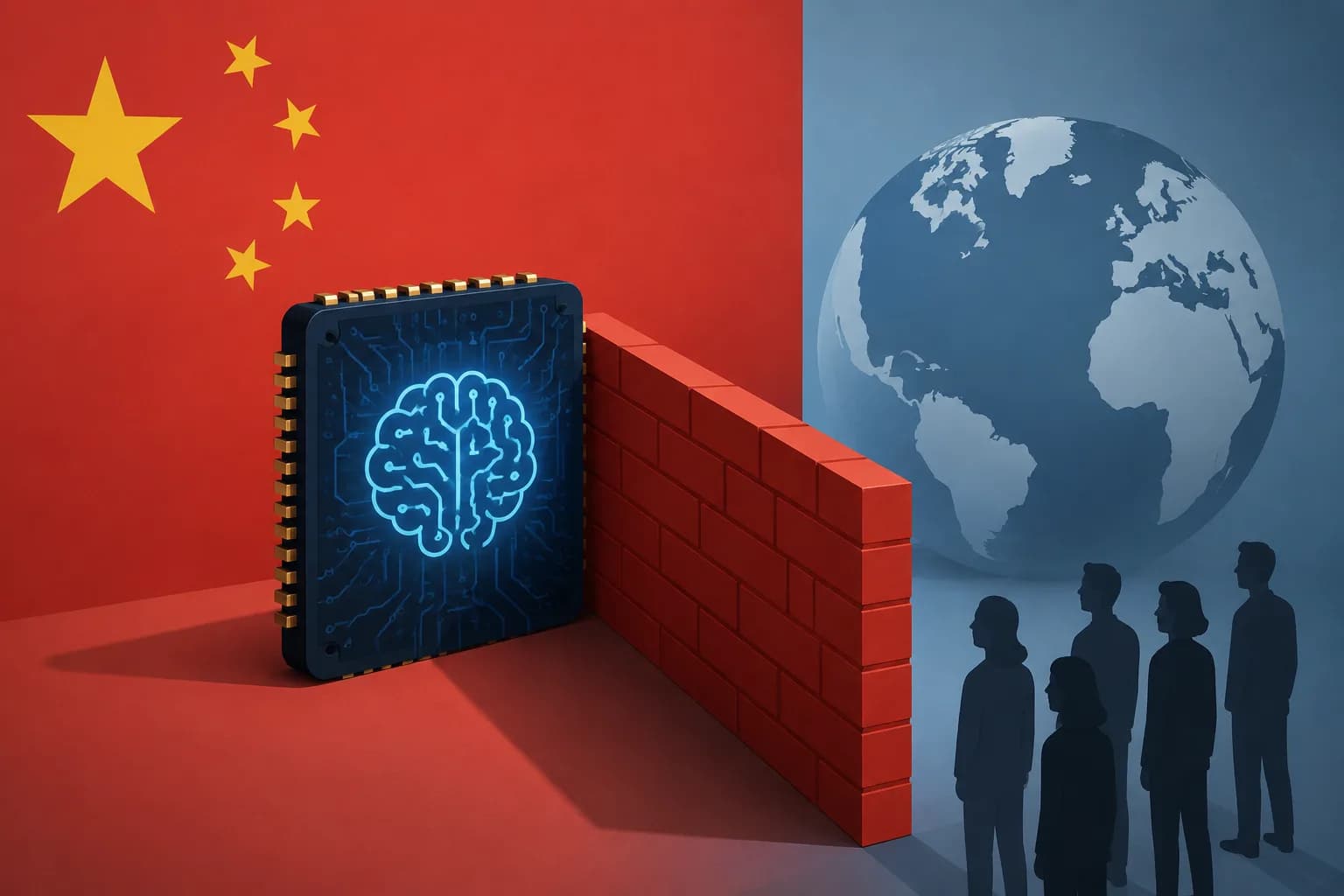
Chinese authorities have held meetings with major tech companies over the past month to discuss whether overseas access to China’s most advanced artificial intelligence (AI) models should be restricted.
The discussions included models that have not yet been released, signalling that Beijing is considering tighter control over a sector it increasingly treats as strategically sensitive, Reuters reported, citing three people familiar with the talks.
Also Read | Nicki Minaj’s ‘game over’ post after meeting Trump sparks online debate
China considers restricting global access to its top AI models, including ones not released yet. Alibaba, ByteDance and Z/ai got the summons. Leaking a model may soon count as treason. Beijing spent years pushing homegrown AI onto the world. Now it wants to lock the door behind…
— Lukasz Olejnik (@lukOlejnik) July 7, 2026
The first moves behind closed doors
The meetings were led by China’s Ministry of Commerce and were attended by officials from the National Development and Reform Commission, the state planning agency.
Companies present included Alibaba, ByteDance and Z.ai. The talks focused on possible limits for the most advanced models, covering both closed-source systems and open-weight models that users can download, run and customise.
Officials discussed whether leaks or thefts of proprietary AI technology could be made punishable under China’s national security law.
🚨 China considers BLOCKING external access to its top AI models.
— Luiza Jarovsky, PhD (@LuizaJarovsky) July 7, 2026
This is concerning for U.S. companies, as various frontier and highly specialized agentic AI use cases today rely on open-source AI models, often Chinese ones.
The adolescence of AI policy is here, triggered by… pic.twitter.com/wWFdbvjqKR
Much discussed, little decided
The scope of any restrictions remains undecided. Officials have not clarified whether the rules would apply only to future models. It was also not immediately clear when, or even whether, the measures would take effect.
Neither the commerce ministry nor the National Development and Reform Commission responded to Reuters requests for comment, and Alibaba, ByteDance and Z.ai did not comment.
The companies involved operate a mix of closed-source and open-weight systems, with Alibaba’s Qwen and ByteDance’s Doubao among the most widely used AI models in China.
Z.ai’s GLM-5.2 has also drawn attention in Silicon Valley for approaching leading US offerings at a lower cost.
This is the first real AI cold war.
— Ricardo (@Ric_RTP) July 6, 2026
Anthropic is HIDING secret spy code inside its most popular coding tool.
The code was designed to identify Chinese users without their knowledge.
Now Alibaba has banned every single Anthropic product from its entire company.
And the full… pic.twitter.com/niEvXsYt4J
The tale grows rather more intricate
The discussions come as China has moved through a series of measures this year aimed at keeping advanced AI technologies under closer domestic control.
In April, the state planner ordered Meta to unwind its $2 billion acquisition of Chinese-founded AI startup Manus, and in early June, authorities issued new rules tightening oversight of overseas deals involving Chinese investors, technology, data and national security.
Investigations have also been launched into Manus and other local AI startups that moved abroad.
AI IS A FAUCET THEY CAN SHUT OFF
— Javi Lopez ⛩️ (@javilopen) July 7, 2026
🇨🇳 China could SHUT OFF its AI models from the rest of the world to keep all the competitive advantage for itself.
🇺🇸 The US already did it for a while with Fable/Mythos, and could do it again in the future.
🇪🇺 Meanwhile, EUROPE is becoming… pic.twitter.com/3psW1ZHENV
When algorithms become affairs of state
The policy debate also reflects a broader national security lens around AI. The Trump administration has been concerned about the misuse of US AI products by military intelligence in China, Russia and other countries of concern.
In June, US authorities ordered that foreign nationals not have access to Anthropic’s most advanced models, and the company later lifted some restrictions on one model after safeguards were added.
Another model remains limited to trusted US organisations. Chinese officials, meanwhile, are said to be worried that advanced foreign AI systems could be used against Chinese interests.
Sam Altman was asked why the US shouldn't just race China on AI at full speed. His answer breaks the race logic exactly where the stakes are highest
— Karl Mehta (@karlmehta) July 3, 2026
"I think it's fine to say, hey, we're going to win this. We're going to have most of the economic benefit"
"But there will be… pic.twitter.com/KqWkcnR9BU
Beyond China’s borders, the stakes rise
If Beijing moves ahead, the impact could extend beyond China’s borders. Chinese AI models have made major gains globally since DeepSeek’s R1 emerged last year, and any new curbs on overseas access could raise costs for businesses that use these systems.
There have been reports pointing to an emerging regulatory framework discussed by Chinese legal experts in May, under which basic open-source tools would face light filing requirements.
The more advanced technologies would undergo security reviews, and the most sensitive frontier models could be barred from public release or restricted to domestic use.
Also Read | EASA extends conflict-zone bulletin, tells airlines to avoid Iran, Iraq and Lebanon
FAQs
Q1: Why is China considering restricting overseas access to its AI models?
China is considering the move to reduce national security risks and prevent advanced AI technology from being leaked or misused abroad.
Q2: Which Chinese AI companies could be affected by the proposed restrictions?
According to Reuters, companies including Alibaba, ByteDance and Z.ai participated in discussions over potential limits on overseas access to advanced AI models.