

























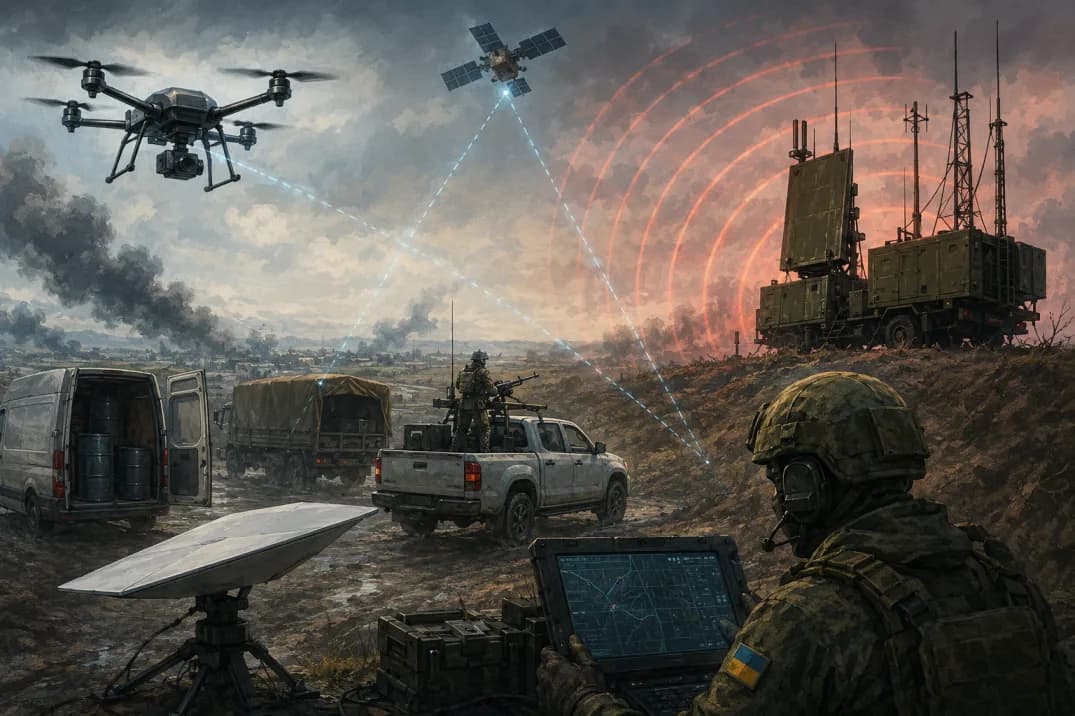
Russian forces are trying to counter Ukraine’s drone attacks by hiding fuel and other military supplies in civilian vehicles and deploying jamming systems aimed at disrupting Starlink satellite internet links, Ukrainian drone commanders and pilots informed in Ukraine’s southern Zaporizhzhia region on July 8.
Kyiv’s “mid-strike” drones, which can hit targets dozens of kilometres behind front lines and are often flown through Starlink, have become a major feature of the war by striking supply lines, fuel storage sites, air-defence systems and command centres.
Those attacks, according to the Ukrainians, have disrupted Russian logistics and contributed to fuel shortages in Russian-occupied Crimea.
Also Read | EASA extends conflict-zone bulletin, tells airlines to avoid Iran, Iraq and Lebanon
Russia Deploys Powerful Electronic Jammers to Disrupt Musk's Starlink
— Mossad International (@MossadInterpol) July 8, 2026
Russian forces are deploying advanced electronic jamming systems to disrupt Elon Musk’s Starlink satellite network, aiming to neutralize remote communication links that power Ukraine’s highly effective… pic.twitter.com/hWPn8T15dF
A game of signals and shadows
The commanders said Russian countermeasures range from simple concealment to more advanced electronic warfare.
Jamming devices have been installed near towns and military facilities, including systems that can disrupt Starlink connections operated by Elon Musk’s SpaceX, they said.
Serhii Beskrestnov, an adviser to Ukraine’s defence ministry, said that Russia was using a system called Volna Kupol Garant, which he said emits a signal strong enough to destabilise Starlink over an area of about 20 square km, with about 10 such systems detected so far.
Ukraine’s mid-strike missions are flown using Starlink, which the commanders said had previously been seen as largely immune to jamming.
🇷🇺🛰Russia is deploying new electronic warfare systems to suppress Starlink on the front lines, according to Reuters
— dana (@dana916) July 8, 2026
According to Ukrainian commanders and drone pilots, the Russian Armed Forces are installing powerful devices to create interference near cities and military sites… pic.twitter.com/wsAwqoMhF7
A counterstroke with impeccable timing
Ukrainian crews said they have already targeted some of those jamming systems. The 422nd Unmanned Systems Regiment has taken part in operations against two such installations, including one struck hours after it was detected in a joint mission with the SBU security service, according to Kolesnyk, one of the commanders.
In one attack, a drone hit a site containing six large boxes resembling trailers, and a crew commander using the callsign “Dyryhent” said, “As soon as we struck that installation, our Starlink-equipped (drones) flew without problems.”
Reuters said SpaceX did not respond to a request for comment, and Russia’s defence ministry also did not respond, and the outlet noted it could not independently verify the tactics described by the Ukrainian commanders.
Russia is deploying powerful jamming systems targeting Elon Musk's Starlink. Ukraine has been leveraging Starlink-guided drones to strike fuel depots, air defence systems, command centres, and supply lines positioned deep within Russian territory. The jamming effort appears aimed… pic.twitter.com/iOJIivyBZD
— Kyledoops (@kyledoops) July 8, 2026
Supply lines under a clever disguise
The Ukrainian commanders also described a broader pattern of Russian supply discipline designed to reduce the risk from drone strikes. Kolesnyk said his unit had hit water tankers carrying gasoline and painted-up milk trucks that had diesel fuel inside.
He said Russian forces were running small fuel convoys protected by pickup trucks with mounted machine guns, taking smaller roads to avoid surveillance and using civilian vehicles to move supplies.
Ukraine’s military intelligence reported that Russian forces were also using small civilian cars, quadbikes and motorcycles to transport fuel, ammunition and provisions, while camouflaged dugouts, abandoned buildings, agricultural structures and civilian petrol stations were being used to conceal or store supplies.
Rob Lee, a senior fellow at the US-based Foreign Policy Research Institute, added that the mid-strike campaign was “perhaps the most important battlefield development this year” but warned that scaling up jammers could make it harder to sustain.
Even so, the campaign has not stopped Russian strikes on Ukraine, and not every Ukrainian drone mission succeeds.
Also Read | Trump orders halt to trade with Spain, presses allies on defence spending
FAQs
Q1: Why is Russia trying to jam Starlink in Ukraine?
Russia is attempting to disrupt Starlink connections used by Ukrainian drones to reduce the effectiveness of long-range strikes on military targets and supply lines.
Q2: How does Starlink help Ukrainian drone operations?
Starlink provides satellite internet connectivity that enables Ukrainian operators to control drones over long distances and carry out precision missions.