

























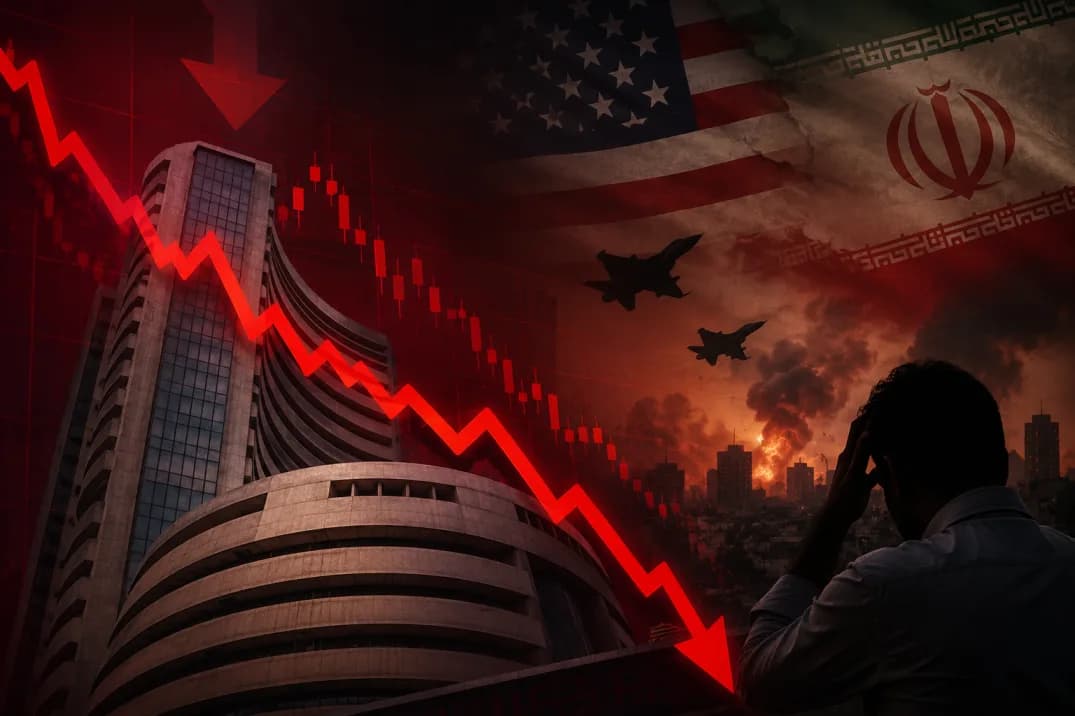
Indian stock markets suffered their sharpest single-day fall since March-end on Wednesday, July 8, as the Sensex dropped 1,677 points to close at 76,503.60 and the Nifty 50 fell 517 points to end at 23,882.05.
The selloff erased more than Rs 8 lakh crore in investor wealth and pulled the combined market capitalisation of BSE-listed companies to below Rs 472 lakh crore.
The decline came as benchmark indices lost more than 2% each, with all Sensex constituents ending in the red and several heavyweight stocks, including InterGlobe Aviation, Maruti Suzuki, Hindustan Unilever, Bajaj Finance, Kotak Mahindra Bank, ITC and Bharat Electronics, falling between 3% and 5%.
Also Read | Trump orders halt to trade with Spain, presses allies on defence spending
Sensex crashed today because Trump is saying cease fire is over
— Anshul Garg (@AnshulGarg1986) July 8, 2026
So we are again going in War zone
They sre clearly playing with stock market
This is not ending soon. https://t.co/bhSzcRaqdB
When distant drums shake Dalal Street
The trigger for the market-wide pullback was a sharp deterioration in geopolitical sentiment after US President Donald Trump said the interim agreement with Iran was “over”.
Trump also described the situation as a “waste of time” and called Iran’s leaders “sick people” after a fresh wave of strikes in the Gulf threatened to derail the fragile ceasefire.
Washington had carried out airstrikes on Iran and reinstated sanctions on Iranian crude sales, while US Central Command said its forces had begun a series of strikes in response to attacks on commercial shipping in the Strait of Hormuz.
Trump’s remarks came as fighting flared again between Tehran and Washington, adding to fears that the truce had collapsed.
FIIs & DIIs both net BUYERS today, but Sensex still crashes 1,677 points? 🤯 Talk about a plot twist!
— Chandan Taparia, CMT, CFTe, MFTA (@tapariachandan) July 8, 2026
Here is the quick market breakdown behind today's paradox:
Derivatives Dictated the Trend: Institutional green numbers are ONLY for the Cash segment (delivery accumulation).… pic.twitter.com/eREQNgzOLj
Oil lights the fuse
Crude oil prices reacted immediately. Brent crude futures jumped more than 6% to near $79 a barrel, while West Texas Intermediate climbed over 6% to around $75 a barrel.
Investors were worried about supply disruption through the Strait of Hormuz, one of the world’s most critical oil shipping routes. The pressure did not stop there. European markets fell up to 2%, Japan’s Nikkei lost 1.5%, South Korea’s Kospi slumped 6%, and Dow Jones futures were also lower, signalling weakness for Wall Street later in the day.
Back home, India VIX rose 26% to 14.68, broader markets came under strain, and the Nifty Midcap 100 and Nifty Smallcap 100 indices each fell by nearly 2%.
The reckoning reaches every corner
The weakness also spread across sectors and the currency market. All sectoral indices ended in the red, with the Nifty Bank, Nifty FMCG and Nifty Oil & Gas indices falling more than 2% each.
Market breadth was sharply negative, with 2,633 stocks declining on the NSE against 699 advances. The Indian rupee weakened to 95.5550 against the US dollar, its lowest level in nearly a month, as higher crude prices and a stronger dollar weighed on sentiment.
In its outlook, ETMarkets quoted Geojit Investments chief investment strategist VK Vijayakumar as saying investors need to “wait and watch” how the situation unfolds, while noting that further escalation in US-Iran tensions and another spike in oil prices could add pressure to India’s macroeconomic position.
Also Read | EASA extends conflict-zone bulletin, tells airlines to avoid Iran, Iraq and Lebanon
FAQs
Q1: Why did the Indian stock market fall today?
The Sensex and Nifty fell sharply after renewed US-Iran tensions triggered a global risk-off sentiment and pushed crude oil prices higher.
Q2: How do rising crude oil prices affect the Indian stock market?
Higher crude oil prices increase India’s import costs, fuel inflation concerns, and can negatively impact corporate earnings and investor sentiment.